 ®
Direct Answer
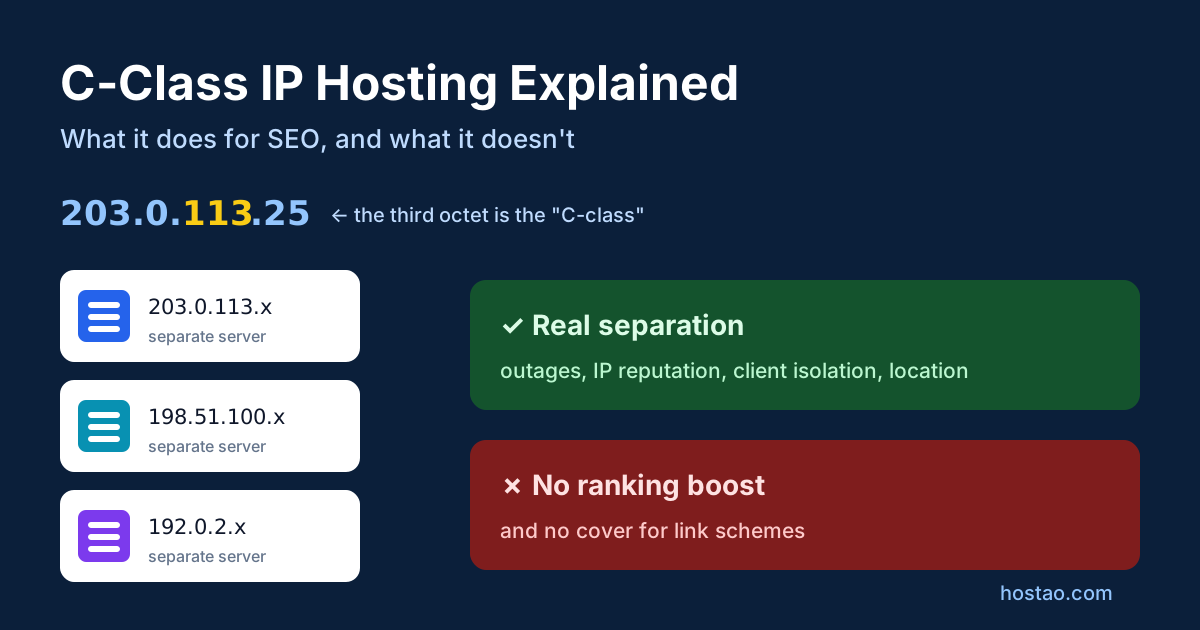
C-class IP hosting spreads your websites across IP addresses whose first three numbers differ, usually on different servers and often in different locations. That gives you real infrastructure separation: one site's outage, abuse report or blocklisted IP is less likely to affect the others. What it does not do is give a site a ranking boost, or make links between your own sites count as independent votes. Google has never documented IP diversity as a ranking factor, and its spam policies treat links built mainly to manipulate rankings as link spam, wherever the sites are hosted.
So the useful question is not "will different IPs help me rank?" It is "do my sites need to be operationally independent from each other?" If the answer is yes, multi-IP hosting can be a sensible, inexpensive way to get there.
What "C-Class" Actually Means
An IPv4 address has four numbers, or octets, such as 203.0.113.25. In the original 1980s addressing scheme, networks were sorted into classes A, B and C by size. That classful system was retired in 1993 when the internet moved to CIDR (Classless Inter-Domain Routing), so on today's internet "C-class" is shorthand rather than a technical category.
In hosting, "different C-class IPs" means addresses where the third octet differs, for example 203.0.113.25 and 203.0.114.25. Each one sits in a different /24 block, the 256-address range that providers commonly allocate together. Two addresses in the same /24 are usually on the same network, and often in the same rack.
| Term used in hosting | What it means in practice |
|---|---|
| Same IP | Many sites share one address, as on most shared hosting |
| Same C-class | Different addresses in the same /24 block, usually the same network |
| Different C-class | Addresses in different /24 blocks, often different servers |
| Different A/B-class | Addresses that differ in the first or second octet, typically different networks or providers |
| Dedicated IP | One address used only by your site or account |
Does a Shared IP Hurt SEO?
For a normal website, no. Shared IPs are the default for most of the web. Popular CDNs serve vast numbers of unrelated sites from the same addresses, and Google ranks those sites on their own content and signals every day. Sharing an IP with sites you do not know is not a ranking problem in itself.
Where a shared IP can cause trouble is reputation outside search:
- Email. If your site sends mail from a shared server and a neighbour sends spam, the server's IP can land on a blocklist and your messages may go to junk.
- Security filters. Some firewalls and corporate networks block IPs with a history of abuse, which can occasionally catch innocent sites on the same address.
- Resource contention. On busy shared servers, a noisy neighbour affects speed and uptime. That is a capacity issue, not an IP issue, but it often gets blamed on "bad IPs". Our guide to what shared hosting actually limits covers this in more detail.
Where Multi-IP Hosting Genuinely Helps
There are good, ordinary reasons to put sites on separate IPs and servers:
- Outage isolation. If your sites live on different servers, a hardware fault or overload on one does not take every project down at once.
- Reputation isolation for clients. Agencies hosting many client sites can keep one client's email or abuse problem from spilling onto another's address.
- Separate ownership and handover. When a client project or a portfolio site might be sold later, running it on its own allocation makes it cleaner to move.
- Location choice. Plans with several server locations let you host a site nearer its main audience, which can help speed.
- Dedicated IP needs. Some setups, such as running mail with its own sending reputation or certain firewall allow-lists, are simpler with a fixed address of your own.
None of these depend on fooling a search engine. They are the same reasons a business would split critical systems across different machines.
What It Will Not Do
It helps to be blunt, because a lot of SEO hosting marketing is not:
- It will not lift rankings by itself. Search performance comes from content, relevance, links earned from other sites and technical health. A new IP changes none of those.
- It will not make self-built link networks safe. Google's spam policies list buying or selling links for ranking purposes, excessive link exchanges, and "creating low-value content primarily for the purposes of manipulating linking and ranking signals" as link spam. Spreading those sites across many IPs does not change what they are, and sites caught this way can drop in rankings or be removed from results.
- It will not hide that sites are related. Search engines see far more than an IP address. Treat IP separation as an operations decision, not a disguise.
If you run several genuine sites, such as regional brands, separate product lines or client projects, linking between them where it is useful to readers is normal. The issue is building sites mainly to pass link value.
Questions to Ask Before You Buy
- How many distinct /24 blocks do I really get? "20 IPs" and "20 different C-class IPs" are not the same thing.
- Are the IPs on different physical servers and locations, or one server with many addresses? Outage isolation only comes from separate servers.
- What is each IP's history? Ask how addresses are checked against blocklists before they are assigned.
- Is there a cPanel account per site, and SSL per domain? That keeps projects independent day to day.
- What happens if an IP is blocklisted? Find out whether the provider replaces it, and how quickly.
If you only need one or two separate projects, a shared hosting plan with an add-on dedicated IP, or a small VPS, may be simpler. Our comparison of shared hosting vs VPS helps with that decision.
How Hostao's SEO Hosting Plans Fit
Hostao's SEO hosting page lists three multi-IP plans with 5, 20 and 100 different C-class IPs. The smaller two spread sites across the same number of different server locations, and the largest uses a global server network. Each plan includes a cPanel account per site, SSL per domain and NVMe SSD storage; the middle plan adds a dedicated IP option and the largest offers custom IP ranges. Allocations and locations depend on current inventory, so confirm them with the team before you order.
If you are hosting client sites rather than a portfolio of your own, reseller hosting is often the better fit, with WHM to create a separate cPanel account for each client. For partners in several regions, the multi-location reseller plans let you choose a data centre per account.
Frequently Asked Questions
What is C-class IP hosting?
It is hosting that places your websites on IP addresses in different /24 blocks, meaning the third number of the address differs. Usually the sites also sit on different servers or in different locations.
Do different C-class IPs improve Google rankings?
No. Google does not document IP diversity as a ranking factor. Rankings depend on content, relevance, earned links and technical quality.
Is it bad to have many sites on one shared IP?
Not for search. Most of the web shares IPs. A shared IP matters more for email deliverability and blocklists than for rankings.
Is SEO hosting the same as a private blog network?
No. SEO hosting is a type of infrastructure. A private blog network is a link scheme, and using any hosting to build one goes against Google's spam policies.
Who should buy multi-IP hosting?
Agencies that want client sites isolated, owners of several independent sites who want outage and reputation separation, and projects that need a site hosted in a specific region.
Sources
- Google Search Central, Spam policies for Google web search (link spam section), checked 15 October 2026.
- IETF, RFC 4632: Classless Inter-domain Routing (CIDR), which replaced classful addressing.
- Hostao SEO hosting plans, plan features as listed on 15 October 2026.
Editorial Team
Content strategist and editor specializing in web hosting guides, digital marketing, and business growth strategies.
Ready to Get Started with Hostao?
Compare Hostao hosting plans, review the current checkout terms, and choose the right starting point for your website.
View Hosting Plans