 ®
The Short Answer
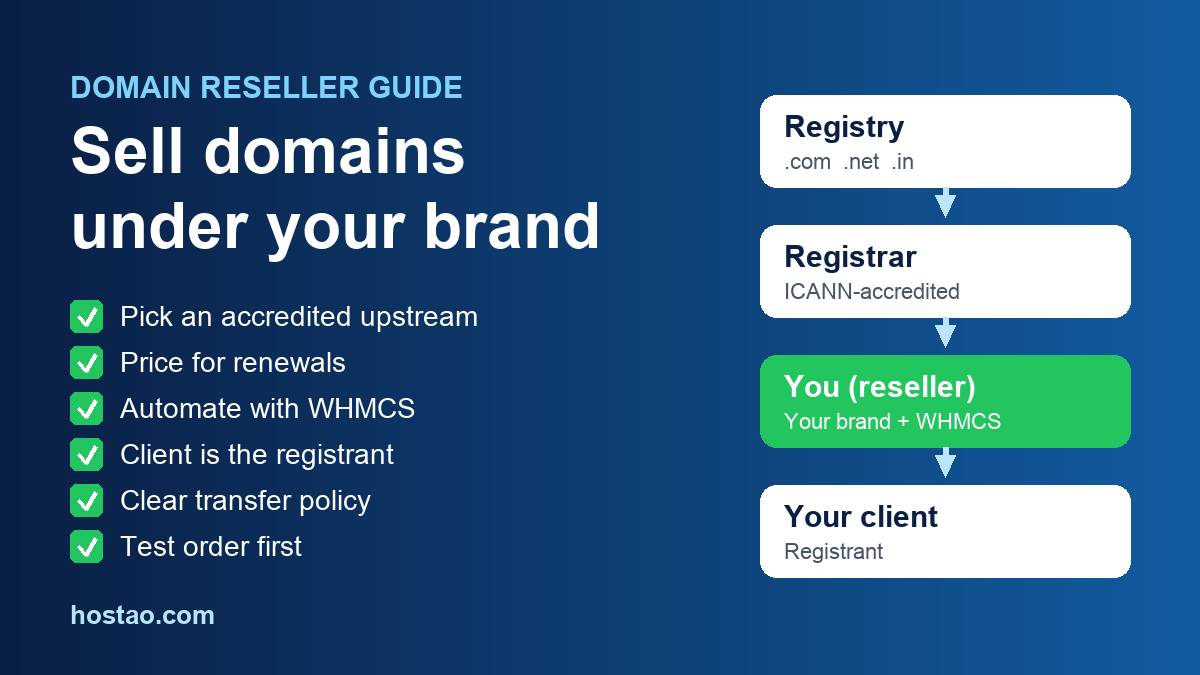
To become a domain reseller, you do not need to become a registrar. You open a reseller account with an upstream provider that is already accredited, load its wholesale prices into a billing system, set your own retail prices, and sell domains to your clients under your brand. The upstream provider holds the registry connection and the ICANN contract. You hold the customer relationship, the pricing and the support.
The work that decides whether this becomes a business or a headache is not the signup. It is choosing the right upstream, pricing renewals honestly, automating registration and renewal through a tool such as WHMCS, and having clear rules for transfers, expiry and ownership before your first client asks.
Reseller or Registrar: Which One Do You Actually Need?
An ICANN-accredited registrar is a company with direct access to the generic top-level domain (gTLD) registries such as .com and .net. Getting there is a serious project. ICANN's published financial considerations list a US$3,500 non-refundable application fee, a US$4,000 yearly accreditation fee, quarterly variable fees, and proof of adequate working capital. For first-time applicants, ICANN says access to US$70,000 or more in liquid working capital is deemed adequate. Accredited registrars also sign the Registrar Accreditation Agreement, arrange registrar data escrow and carry the compliance obligations.
On top of that, ICANN charges a transaction-based fee on each year of a new registration, renewal or transfer. ICANN's fiscal year 2026 fee schedule sets it at US$0.20 per transaction-year.
A reseller skips all of that. Here is the practical difference:
| Question | Domain reseller | ICANN-accredited registrar |
|---|---|---|
| Upfront cost to ICANN | None | US$3,500 application + US$4,000 yearly |
| Registry connections | Provided by the upstream | You build and maintain them |
| Compliance and escrow | Mostly handled by the upstream | Your responsibility |
| Your brand on the client side | Yes, with a white-label setup | Yes |
| Time to first sale | Days | Months |
| Best for | Agencies, hosting resellers, freelancers | High-volume domain businesses |
If you sell domains to the clients you already build or host websites for, reselling is almost always the right starting point. Accreditation only starts to make sense at a volume where the margin covers the fixed fees, the staff and the compliance work.
Step 1: Decide What You Are Really Selling
Most successful domain resellers do not compete on price alone. The cheapest .com on the internet is a race you cannot win against the largest registrars. What you can win is convenience: the client gets the domain, DNS, email, hosting and website from one trusted supplier who answers the phone.
Write down, before you pick a provider:
- Which clients you serve: local businesses, ecommerce stores, agencies, regional markets
- Which extensions they ask for. A UAE client may need .ae, an Indian client .in, a Bahrain client .bh. Country-code domains have their own eligibility rules, so check them first. Our guide to .ae domain registration rules shows how specific these can be.
- Whether you bundle domains with hosting or sell them on their own
- Who handles support when a domain stops resolving at 11 pm
This list decides which upstream you need. A reseller who only sells .com and .net has many choices. A reseller who must also sell regional ccTLDs needs an upstream that actually supports them.
Step 2: Choose an Upstream Provider
Your upstream is the accredited company whose platform you resell. Compare providers on these points, in this order:
- Extension coverage. Confirm every extension your clients need is supported, including ccTLDs with local presence rules.
- Renewal prices, not just registration prices. First-year promotional prices are common. Your margin lives in renewals.
- Billing integration. Check that a maintained module exists for your billing system. WHMCS ships with registrar modules for providers such as Enom, OpenSRS, ResellerClub, Namecheap and CentralNic Reseller, and it supports third-party modules too.
- API and white-label options. Your clients should see your brand, your nameservers and your support details.
- Deposit and payment model. Many reseller accounts work on prepaid funds. Understand the minimum deposit and what happens to a renewal if your balance runs low.
- Support quality. When a transfer gets stuck, you need a person at the upstream who answers.
Hostao runs a domain reseller programme with WHMCS-related tooling, API access and white-label options. As with any provider, confirm the current pricing and onboarding details for your extensions before you order.
Step 3: Set Up Billing and Automation
Selling domains by hand works for the first five clients. After that, missed renewals and manual invoices start costing you money and trust. A billing platform automates the routine work.
In WHMCS, registrar modules live under Configuration > System Settings > Domain Registrars. You activate the module for your upstream and enter your API details. The WHMCS documentation also points to three settings that matter early:
- Default nameservers for domain-only orders, set in the Domains tab of General Settings. Use your own branded nameservers if your upstream allows them.
- Automatic registration per TLD, under Domain Pricing. WHMCS lets you pick a different registrar for each extension, so you can use one supplier for .com and another for a regional ccTLD.
- Domain synchronisation, under Automation Settings, which keeps expiry dates, due dates and statuses in line with your registrar.
If you are setting up WHMCS for the first time, work through our WHMCS setup checklist for hosting resellers before your first order. It covers the payment gateway, tax, email and test-order steps that this guide does not repeat. Whether a WHMCS licence comes with your plan depends on the plan, so check the current terms on our Free WHMCS page.
Step 4: Price for Renewals and Real Costs
A pricing model you can defend has four parts:
- Wholesale cost for registration, renewal and transfer, per extension
- Pass-through fees, such as the ICANN transaction fee, which your upstream usually builds into its price
- Your time: setup, DNS changes, support and the occasional transfer dispute
- Risk: chargebacks, unpaid renewals you had to cover, and currency movement if you pay the upstream in US dollars and bill clients in rupees or dirhams
Here is an illustrative example. The numbers are invented to show the method, not a quote:
| Line | Example |
|---|---|
| Wholesale .com renewal | 10.00 |
| Payment gateway fee (about 3%) | 0.45 |
| Support and admin time allowance | 2.00 |
| Margin | 2.55 |
| Retail renewal price | 15.00 |
Two rules keep pricing honest. First, show the renewal price at the point of sale, not only the first-year price. Clients who feel tricked at renewal time leave. Second, review wholesale prices every quarter. Registries change prices, and a margin that was fine last year can turn negative.
Step 5: Write Your Domain Policies Before You Need Them
Every reseller eventually meets the same four situations. Decide how you will handle them now.
Ownership. Register the domain in the client's name, with the client's real contact details, not yours. ICANN tells registrants that they must give their registrar accurate and reliable contact information, and that not responding to a registrar's request to confirm it within 15 days will likely lead to suspension or even cancellation. Use a contact email the client actually reads. Registering a client's domain under your own name may feel convenient, but it creates disputes when the relationship ends.
Transfers. ICANN's registrant transfer FAQ explains that a registrar may deny a transfer within 60 days of initial registration or of a previous transfer, and that changing the registrant name, organisation or email can trigger a 60-day lock. Tell clients this before they change details or ask to move. Hand over the Auth-Code (transfer code) promptly when a client asks. Holding a client's domain hostage damages your reputation fast.
Expiry. Turn on automatic renewal reminders and keep enough funds with your upstream. A business losing its domain because your deposit ran dry is the worst support ticket you can get. Our domain expiry protection checklist lists the reminders and checks to set up.
Security. Protect your reseller account and your WHMCS admin with strong, unique passwords and two-factor authentication. One stolen reseller login can expose every client domain at once. If a client domain is ever hijacked, our guide to recovering a stolen domain explains the first steps.
Step 6: Launch With a Small, Tested Offer
Do not launch with 200 extensions. Start with the five or six your clients actually buy, test the full journey yourself, and expand later:
- Place a real test order and register a domain end to end.
- Change nameservers and DNS records, and confirm they resolve. If you plan to move client sites, keep our DNS TTL cutover checklist at hand.
- Check the renewal invoice WHMCS generates for a test domain.
- Request an Auth-Code and confirm your process for giving it to a client.
- Check that the emails your clients receive carry your brand and support contacts, not the upstream's.
Once that works, add domains to your existing offers. A domain, hosting and business email bundle is easy to explain and easy to renew. If you also want to sell hosting under your own brand, compare our reseller hosting plans.
Common Mistakes New Domain Resellers Make
- Competing only on price. You will lose to the largest registrars and earn nothing.
- Hiding renewal prices. It creates refund requests and complaints.
- Registering client domains in your own name. It turns every client exit into a dispute.
- Letting the prepaid balance run low. Renewals fail quietly.
- Skipping the test order. Your first client becomes the tester.
- No written transfer policy. Clients ask at the worst possible moment.
FAQ
Do I need ICANN accreditation to sell domains?
No. Resellers sell through an accredited registrar's platform. Accreditation is only needed if you want direct registry access, and it comes with application fees, yearly fees, working-capital requirements and compliance work.
How much does it cost to start a domain reselling business?
It depends on the upstream. Many reseller accounts work on prepaid funds rather than a large signup fee. Your real costs are the wholesale prices, your billing software, payment gateway fees and your support time.
Can I sell country-code domains like .in, .ae or .bh?
Yes, if your upstream supports them. Each ccTLD has its own eligibility and document rules, so check them for every extension before you add it to your price list.
Can I use WHMCS with more than one registrar?
Yes. WHMCS lets you choose the automatic registration registrar per TLD, so you can use different suppliers for different extensions.
Who owns a domain I register for a client?
The registrant named in the registration record. Name the client as the registrant, with accurate contact details, unless you have a clear written agreement that says otherwise.
Sources
- ICANN: How to Become an ICANN-Accredited Registrar
- ICANN: Registrar Accreditation: Financial Considerations
- ICANN: Registrars Approve Registrar-Level Fees for Fiscal Year 2026
- ICANN: FAQs for Registrants: Transferring Your Domain Name
- ICANN: FAQs: Registrant Contact Information and the Registration Data Reminder Policy
- WHMCS Documentation: Domain Registrars
Editorial Team
Content strategist and editor specializing in web hosting guides, digital marketing, and business growth strategies.
Ready to Get Started with Hostao?
Compare Hostao hosting plans, review the current checkout terms, and choose the right starting point for your website.
View Hosting Plans